Friday, January 20, 2006
Blog Maintenance
Sharp-eyed observers of this blog will notice that I've been experimenting with different background colors. This is in an effort to come up with a somewhat warmer and easier-to-read look. Comments are appreciated. I personally like the white-on-blue content, but I'm not quite sure about the silver titles against the blue. The pictures seem to look good on this background as well. Stay tuned. I also fixed the link to Kyle Gann's Postclassic Radio station, so that it works now, in case you tried it before and got frustrated.


Thursday, January 12, 2006
Happy Birthday, Morton Feldman

A busy day awaits, but I'd be remiss if I didn't acknowledge this baffling and wonderful composer who has provoked more astonishment, confusion and delight in my being that any other composer I can think of. A loud, boisterous (an adjective that doesn't even begin to describe some stories I've been told) man who wrote the quietest, most delicate pieces of music we've yet heard. And some of the longest ones. Relatively obscure while he was alive, now we're all trying to grapple with his legacy. I never met him, but my friend Thomas L. Hamilton did. Hearing Feldman's "The Viola in My Life" in Buffalo in 1996 is an experience that I'll be grateful for as long as I live. I hope wherever he is now, the musicians are playing as softly as he wants them to. (Above image from Feldman archive at University at Buffalo)
Update: the crew at the KC Symphony that I work with had a banner Morton Feldman B-Day, listening to "Clarinet and String Quartet," "The Viola in my Life," "Coptic Light," "Why Patterns?" and a few others.
Monday, January 02, 2006
Derek Bailey, R.I.P.
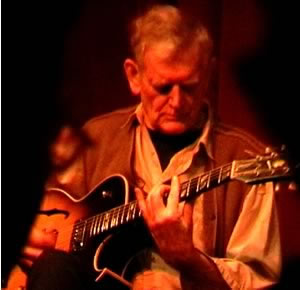
British guitarist Derek Bailey passed away yesterday at 75. One of the foremost exponents of the style of free improvisation that emerged in the 1960s and '70s, Bailey was a remarkably industrious musician, churning out dozens of albums and performing at a harrowing pace that only seemd to increase in his old age. He had incredible technique, summoning sounds from the guitar that had never been heard before and forged a highly personal style utterly devoid of sentiment. He could play spontaneously in real time material that other avant-garde composers would have had to labor for weeks to produce. And he developed a circle of dozens of musician collaborators that encompassed such musicians as Anthony Braxton, Evan Parker, Han Bennink, John Stevens, Steve Lacy, John Zorn, and Pat Metheny.
The NY Times obituary included the following description: "Mr. Bailey explained his art unpretentiously, often simply as a matter of personal choice, but his style of playing guitar was a kind of reaction against all systems in music. By the 1970's it had become a system unto itself - a virtuosic, physical one, of clicks and chimes and harmonics and aggressive bursts of volume, arrhythmic and nonlinear but still coherent and powerful." (Read it in its entirety here: http://www.nytimes.com/2005/12/30/arts/30bailey.html )
His music posed as many questions as it answered, and remains a provacative legacy for many of us. For me personally, it sparked a questioning of the notion of notation that I struggle with to this day. In addition to his many albums, he also wrote a fascinating book on improvisation. It's nearly impossible to recommend anything, but for the interested, check out his 'Ballads' disc on Tzadik (where he refracts jazz standards into his own fragmentary language), his duo work with Evan Parker, or the amazing three-disc set that he made with Pat Metheny and two percussionists, 'The Sign of Four.' I admire his solo recordings on Incus as well.
Monday, December 26, 2005
A Composer's Bookshelf
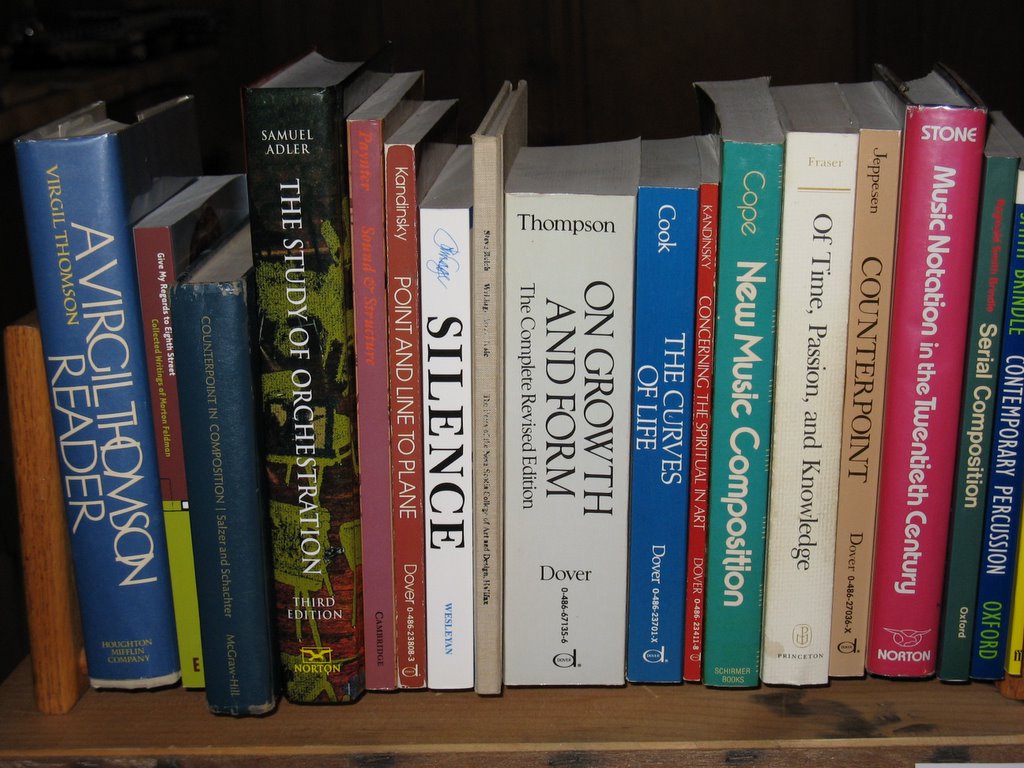
The titles that follow have proved to be of great value to me over the years as compositional resources and they have offered (and continue to offer...) tremendous insight and aid in matters of technique, aesthetics, style, formal design and notation. It is a very personal list, which focuses on those books which have been most meaningful to me. My basic test for inclusion on the list was to ask myself if I still continued read from the book ever (we all have those books that we’ve only read once...), and if its contents had ever been influential on the composition of any particular work of mine. Expect periodic additions and revisions...
Adler, Samuel. 'The Study of Orchestration' (Third Edition). New York: W.W. Norton and Company, 1989
“Sam’s book is like his music: copious.” remarked my teacher Albion Gruber when I asked him about the then recently-published first edition. He also used its substantial heft as a doorstop for his office, and was once embarrassed when Adler paid him a surprise visit one afternoon and saw his proud effort propping Albion’s door open. The text is indeed thorough and reflects Adler’s lifetime summation of experience as a composer and conductor in instrumental scoring. Nits may be picked, as did some of my Eastman chums who complained of his omission of the accordion, among other things. Still and all, accordions aside, this is probably the best single-volume orchestration text today, and it made Adler a millionaire in the process. I have my own complaints about it, but I still use it often. A newer, third edition has just been issued, with many improvements.
Brindle, Reginald Smith. 'Musical Composition.' London: Oxford University Press, 2002.
This book could usefully function as the textbook for a composition class, but it also serves as an excellent guide to various compositional issues such as vocal and choral writing, various contemporary modes of style, formal design, etc. Brindle doesn’t have a compositional or ideological ax to grind, but sticks to practical matters. Even experienced composers need to be reminded of musical first principles, and this book has more compositional horse sense per page than many other, more ideological or idealistic writings.
Brindle, Reginald Smith. 'Contemporary Percussion.' London: Oxford University Press, 1991.
While not as all-encompassing as James Blades’ gigantic tome on percussion (which I never bought), it covers most issues very thoroughly. Lots of score examples are included throughout and Brindle’s advice is always sound and based on a vast fund of personal experience.
Brindle, Reginald Smith. 'Serial Composition.' London: Oxford University Press, 1966.
This is a very good primer for the basics of serial techniques. It was very helpful to me back at a time when I thought that I wanted to be a serial composer. That said, Brindle’s advice on voicings, melodic contour, etc., still carries a lot of water whatever the context—serial or otherwise.
Cook, Theodore Andrea. 'The Curves of Life.' New York: Dover Publications, Inc., 1979. (Originally published by Constable and Company, London, in 1914.)
This book is an exhaustive study of the spiral whose fundamental mathematical expression is the Golden Section or Ø. Cook focuses mostly on its relation to natural phenomena, but also connects it to ideas on the essence of beauty and man’s response to that.
Cowell, Henry. 'New Musical Resources.' (with notes and an accompanying essay by David Nicholls) Cambridge: Cambridge University Press, 1996.
Originally published in 1930, this volume has held up very well over the years. It continues to offer a wide array of techniques and stylistic possibilities, as well as an important discussion of rhythm as an extension of the harmonic series, later utilized and expanded upon by several post-WW II avant-gardists, notably Stockhausen. The music of Conlon Nancarrow wouldn't exists without this book.
Blackwood, Easley. 'The Structure of Recognizable Diatonic Tunings'. Princeton: Princeton University Press, 1985.
Blackwood seems to contradict himself at times, by patiently explaining the inner workings of a particular tuning, and then proclaiming the tuning’s drawbacks in the next paragraph. He is particularly harsh on just intonation and declares it unworkable in all keys--that is, it is impossible to construct a system of just intonation which allows one to play in all keys, a statement which LaMonte Young would appear to have effectively refuted with his towering Well-Tuned Piano piece. Ben Johnston, Harry Partch and Terry Riley also have made effective statements in that tuning. Still, Blackwood has made the structure of various temperaments fairly clear to someone with a bit of patience.
Cage, John. 'Silence.' Middletown, CT: Wesleyan University Press, 1961.
Cope, David. 'New Music Composition.' New York: Schirmer Books, 1977.
While I haven’t actively used this book in some time, it was an important step for me to read it. I carried it everywhere I traveled for a number of years. Cope gives a good overview of various compositional techniques that have emerged in the twentieth century.
Erickson, Robert. 'Sound Structure in Music.' Berkeley: University of California Press, 1975.
Now here is a lost gem. I can’t remember where I found my copy, but it’s been on my shelf of treasured music books for nearly twenty years. Erickson gives here the most coherent examination of timbre and its musical implications that I’ve ever read. The acoustical principles underlying his ideas are carefully integrated into each topic.
Feldman, Morton. 'Give My Regards to Eighth Street: Collected Writings of Morton Feldman.' Cambridge, MA: Exact Change Press, 2000.
This collection of essays and transcriptions of informal remarks gives a nice insight into the milieu of the New York modernist art scene in the late 50s and early 60s. Feldman was apparently never concerned with creating a theoretical rationale for his music, and none is to be found here, but his remarks about color and proportion, however seemingly offhand, deserve close consideration.
Huntley, H. E. 'The Divine Proportion: A Study in Mathematical Beauty.' New York: Dover Publications, Inc., 1970.
A superb explication of the Golden Section, with a rather unusually subjective aesthetic viewpoint to have been written by a mathematician. Huntley devotes a large amount of the book to discussing the GS connection to nature and art.
Kandinsky. Wassily. 'Concerning the Spiritual in Art.' New York: Dover Publications, Inc., 1977
Kandinsky. Wassily. 'Point and Line to Plane.' New York: Dover Publications, Inc., 1979
Klee, Paul. 'Pedagogical Sketchbook.' London: Faber and Faber, 1953
Kramer, Jonathan. 'The Time of Music.' New York: Schirmer Books, 1988.
Kramer’s book is a downright pleasurable read and will provoke much thought. His is the first comprehensive attempt to account for the issue of time, as it applies to music. His ideas on proportion and the Golden Section have been very influential on my own composing. His analysis of Stravinsky’s Agon is very interesting, although I was never able to reproduce his results myself.
Mellors, Wilfrid. 'Music in a New Found Land.' New York: Oxford University Press, 1987.
Mellors has written one of the best overviews of American music that I have encountered. Originally published in 1964, Mellors updated the book with an extensive introduction in ‘87. His views on the aesthetic differences between Reich and Glass in his discussion of the rise of minimalism is very compelling. While a lot has happened in the meantime, I personally find that very few of his assessments are in need of much revision. Also notable is the fact that he treats jazz composers and artists with the same seriousness of purpose that he discusses America’s “classical” composers.
Paynter, John. 'Sound and Structure.' London: Cambridge University Press, 1992.
A book with equally compelling implications for composers and educators, Paynter’s book has a lot of good material and possibilities for the teaching of composition.
Reich, Steve. 'Writings About Music.' Halifax: Press of Nova Scotia College of Art & Design, 1974.
I found this in a used bookshop while wandering down Broadway with Tom Hamilton. It chronicles the beginnings of the minimalist trajectories of both Reich and Philip Glass (who were collaborators for a time, playing in each other’s ensembles) and provides the evolution of Reich’s compositional processes. It’s recently been reprinted in a much-expanded form by Oxford University Press.
Salzer, Felix and Schachter, Carl. 'Counterpoint In Composition.' New York: McGraw-Hill Book Company, 1969
Presently out of print, this classic volume covers contrapuntal technique for both Renaissance and Baroque styles. It seems (to me) to be based on the work of Fux and Jeppeson, but viewed through a Schenkerian prism. For an exhaustive overview of species counterpoint, it can’t be beat, although it is essentially mum about rhythmic practices of either era.
Schafer, R. Murray. 'The Thinking Ear.' Toronto: Arcana Editions, 1986, 1988.
Besides being a remarkable composer, Schafer is a remarkable thinker on musical matters. These essays deal with the role of the composer in society, issues of music education and the small matter of what music is in the first place.
Schafer, R. Murray. 'The Tuning of the World.' Toronto: McClelland and Stewart Ltd., 1977.
Schafer here discusses the relationship between Man and his acoustic environment. Schafer’s observations and musings should be read by more than just musicians, but composers will have a lot to ponder from these pages.
Schafer, R. Murray. 'Patria and the Theatre of Confluence.' Indian River, Ontario: Arcana Editions, 1991.
Patria is the title of a cycle of iconoclastic operas and dramatic projects on which this composer has been laboring for many years. Here are Schafer’s essays towards a new kind of musical theatre--one which is integrated with the natural environment and which holds the possibility of real participation from the audience. The book is also an account of the successes and failures that he’s experienced in trying to mount these works over the years.
Stone, Kurt. 'Music Notation in the Twentieth Century.' New York: W.W. Norton & Company, 1980
If there is a notational question that this book cannot answer, I’ve never had to ask it.
Thompson, D’Arcy Wentworth. 'On Growth and Form.' New York: Dover Publications, Inc. 1992 (Unabridged reprint of the 1942 Cambridge University Press edition.)
This is a classic text in the world of biology and was Harrison Birtwistle’s bedside reading for many years. (Maybe it still is...) Thompson’s book is a minute examination of how creatures’ various forms or shapes determine their function in nature. Beyond the fact that this is a landmark in scientific thinking, Thompson’s writing is a pleasure to read because of his supremely literate style.
Thomson, Virgil. 'A Virgil Thomson Reader.' Boston: Houghton Mifflin Company, 1981.
Quite simply, this is the best music writer America has yet produced. Thomson’s criticism is peerless; cf. his remarks on Messiaen’s superiority over other post-war avant composers: “...because his music vibrates, and theirs doesn’t.” The book is divided into a large autobiographical section, followed by reviews, essays and an interview with VT by John Rockwell. Thomson’s views can be rather trenchant, but they’ve held up remarkably well over the years. The only place where I think he slips badly, is in his assessment of Sibelius. (“Provincial...”) But few writers of his or our time could write equally comfortably about Xenakis, Beethoven, shape-note singing, or black gospel music and jazz—Thomson could and did—enthusiastically.
Unutterably Beautiful
Morton Feldman: Late Works with Clarinet (Mode 119)
Three works, from 1971, '81 and '83. At this point in his career, Feldman simply wrote the instrumentation for the title. Thus we have "Three Clarinets, Cello and Piano," "Bass Clarinet and Percussion" and "Clarinet and String Quartet." Carol Robinson, the principle clarinetist, leads the musicians in immeasurably subtle readings of these works. Her musicianship is as impeccable as her understanding of the repertoire: "This is not intellectual music."
Three works, from 1971, '81 and '83. At this point in his career, Feldman simply wrote the instrumentation for the title. Thus we have "Three Clarinets, Cello and Piano," "Bass Clarinet and Percussion" and "Clarinet and String Quartet." Carol Robinson, the principle clarinetist, leads the musicians in immeasurably subtle readings of these works. Her musicianship is as impeccable as her understanding of the repertoire: "This is not intellectual music."
Saturday, December 24, 2005
Christmas Playlist: 24 December 2005
Messiaen: Vingt Regards sur l'Enfant Jesus/Michel Beroff, piano (EMI 69161)
Frank Martin: Maria-Tryptichon/Bamert (Chandos 9411)
Child of Light: Music for Christmas/Elysian Singers of London (Continuum 1043)
20th Century Christmas Collection/The Sixteen (Collins 12702)
Handel: Messiah/Beecham (RCA 61266)
This last item deserves a comment. Beecham uses the Sir Eugene Goosens arrangement of 'Messiah,' about the most non-historically-correct version you could imagine—using a Mahler-sized orchestra, a huge chorus and Wagnerian soloists. The "Hallelujah Chorus" is a wonderful case in point, with an enormous brass choir buttressing the men's parts, and some poignant snare-drum and crash cymbals adding that extra bit that really says "Christmas." I bet Handel would have loved it.
Frank Martin: Maria-Tryptichon/Bamert (Chandos 9411)
Child of Light: Music for Christmas/Elysian Singers of London (Continuum 1043)
20th Century Christmas Collection/The Sixteen (Collins 12702)
Handel: Messiah/Beecham (RCA 61266)
This last item deserves a comment. Beecham uses the Sir Eugene Goosens arrangement of 'Messiah,' about the most non-historically-correct version you could imagine—using a Mahler-sized orchestra, a huge chorus and Wagnerian soloists. The "Hallelujah Chorus" is a wonderful case in point, with an enormous brass choir buttressing the men's parts, and some poignant snare-drum and crash cymbals adding that extra bit that really says "Christmas." I bet Handel would have loved it.
Thursday, December 22, 2005
New Blog: Colorblind Days and Nights
Over to the right you'll see a handy link to my new blog (as promised), Colorblind Days and Nights, which will exhaustively document my time in the band. Any postings that I made on that subject on this blog will likely migrate over there eventually. Expect postings to happen in bursts, as they'll likely occur in the (increasingly fewer) openings in my schedule. Fans and friends are encouraged to add comments, ask questions, and offer corrections to my occasionally faulty memory.
Saturday, December 10, 2005
Trio Medieval in Kansas City
Last weekend I heard the early-music group Trio Medieval performing at the downtown Catholic cathedral here in Kansas City. They have formed just in time to fill the vacuum left by the retirement of Anonymous 4, and if anything they are even more precise in their singing. I cannot recall ever hearing more perfectly-sung unisons in my life—their three voices fused into a single, intensely-focused timbre. Their intonation and blend were astonishing. Singing a repertoire of medieval and "medieval-sounding" works (mostly on texts about Christmas), they offered an immensely satisfying and inspiring concert.
One non-musical observation: in their promotional photographs and on their cd covers they are depicted as glamorous and statuesque Nordic sirens. In person they are not, though having said that, I found them more appealing in person than their media-crafted image. They are much funkier in appearance and not one of them wore any makeup (unlike every photo I've ever seen of them), and they were much shorter than I expected them to be. I guess cd covers, like television, make you look taller than you actually are...
One non-musical observation: in their promotional photographs and on their cd covers they are depicted as glamorous and statuesque Nordic sirens. In person they are not, though having said that, I found them more appealing in person than their media-crafted image. They are much funkier in appearance and not one of them wore any makeup (unlike every photo I've ever seen of them), and they were much shorter than I expected them to be. I guess cd covers, like television, make you look taller than you actually are...
Thursday, December 08, 2005
Playlist: 8 December 2005
Frank Martin: Mass for double choir (Hyperion 67017)
Kaikhosru Sorabji: Organ Symphony No. 1 (Continuum 1001/2)
Alejandro Viñao: Hildegard's Dream (INA/GRM 244942)
Steve Reich: You Are (Variations) (Nonesuch 79891)
Kaikhosru Sorabji: Organ Symphony No. 1 (Continuum 1001/2)
Alejandro Viñao: Hildegard's Dream (INA/GRM 244942)
Steve Reich: You Are (Variations) (Nonesuch 79891)
Sunday, November 20, 2005
More on Van der Graaf Generator
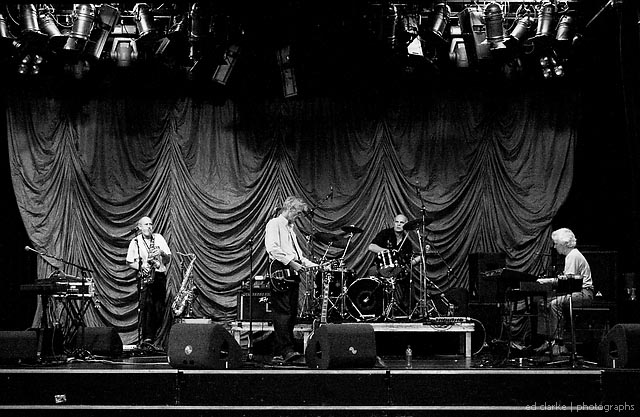
Here's a photo of Van der Graaf Generator rehearsing at Melkweg in Amsterdam last summer, a nice companion to my picture of CbJE playing at the same place, 15 years earlier (see below). I just last week received and listened to VdGG's 'Maida Vale' disc, and for a long-time fan of this band it's a revelation in a number of ways. It prompts a followup to my earlier posting. (See "A Prog-Rock classic, redux") The title refers to the BBC complex of studios (Maida Vale is a suburb of London) where the Beeb daily records bands of all sorts, choirs, orchestras, chamber goups, jazz pianists, you name it—all for broadcast. I myself played there on four separate recording sessions with Colorblind James Experience, and those sessions are a highlight of my time in the band. The amazing thing about these BBC sessions is that they take place in a single day, recording an artist or group in their live essence, but with fantastic audio quality. In my own experience, the necessity of doing everything so quickly brought out a keen spontanaety in us, and these are the only studio documents that really come close to showing the raw power that we could summon as a live band. And so it is with these BBC recordings of VdGG.
The first two tracks are from 1971, taken from their early albums, the remaining tracks are all from '75-76, when the band recorded (and released) three albums in a burnout-inducing frenzy of activity within a single year. The first two of those albums, 'Godbluff' and 'Still Life' were excellent. The third, 'World Record,' had some fine moments, but showed the signs of the band's exhaustion. At the end of their '76 tour, right after the band's only show in the USA, Hugh Banton announced he'd had enough, and this lineup disbanded. So this BBC document serves well as a sort of "best-of" collection, in addition to displaying the band's live sound.
The tracks sample some of the best compositions of the band during their "classic" heyday as a quartet. The musicians are in great form. When I played their records many years ago, I used to wonder "how did this really sound when they played it live?" Now I now know (redundancy alert). Best of all, the production is excellent, in some ways better than their studio albums. Dave Jackson's saxes and electronics are more vivid and immediate, as are Guy Evans' drums. And on the last couple of tracks, we have the only recorded documentation (that I am aware of, at least) of Hugh Banton's monster organ that he designed and built himself, which he dubbed HB1. Attempting to construct an electronic version of a church pipe organ, it has a true 32' stop, as well as some timbres that I don't recall hearing from any other electronic organ. Banton had to use special 24" speakers in order to reproduce the lowest frequencies. It's sad to know that this instrument went into storage after Banton left the band in '76, and was later lost.
Listening to these tracks now, I hear them in the light of my subsequent compositional training and experience as a rock musician. It's interesting to me how concealed the band's virtuosity is. For example, on "La Rossa" the group goes through a bewildering array of odd time-signatures, but because they are composed in support of the words and are completely text-driven, they sound utterly natural, and never draw any attention to themselves. Solo sections tend to be group efforts and rely on rhythmic accumulation rather than individual linear flights, and even with only Banton's organ and Jackson's double saxes, they were capable of fantastically dense textures; the sound is palpably thick, even opaque. I'm noticing now that many of their songs have at least two distinct tempo zones, often in an arch-form or some sort of rondo-like structure. Memorizing some of these must have been a daunting task. Jackson's saxophone electronics were quite innovative at the time, and have aged well, unlike many other players of that era whose recordings just sound gimmicky now.
My wife refers to VdGG a "boy band," not because they ever resembled 'nSync or somesuch group, but because their appeal is largely confined to male listeners. I would agree with this, and I've never met a woman who liked the band, ever. Why this is, I can't say. I do tend to listen to them when she's not around, often on headphones, so I can hear them at something close to the proper volume.
Coming soon...
..."soon" being shortly after this semester closes down, a new separate blog devoted to my memories of playing in Colorblind James Experience. Check the handy list of links to the right. I'm scanning a number of band photos and other memorabilia items that I'll post, along with fascinating anecdotes about the most idealistic band in America in the '80s and '90s. Stay tuned. Regard the CbJE posting below as a preview.
Sunday, November 13, 2005
Colorblind James Experience in Amsterdam, 1990

Here we are at the Melkweg (or "Milky Way"), in the spring of 1990. Left-to-right: David D. McIntire: clarinet and saxophones; Joe "the Bone" Columbo: trombone; Colorblind James: vocals, rhythm guitar, vibraphone, songwriting; Jimmy McAvaney: drums and percussion; Ken Frank: bass guitar; Phillip Marshall: lead guitar, backing vocals.
This was our final tour to Europe, and the first one where we actually made a profit. This was the last show on this tour, and one of the most memorable of our time over there. It's a major club in Amsterdam, still rocking to this day, and there were several hundred people there on this occasion. The picture was taken by our tour manager, Steve Left. Notice how at the end of the tour we were all seriously in need of haircuts...
Saturday, November 12, 2005
Weekend Playlist: 13 November 2005
Horace Tapscott: The Dark Tree-Volume 1 (Hat Art 6053)
Cecil Taylor: Looking (Berlin Version) Solo (FMP 28)
David Lang: Child (Canteloupe 21013)
Pierre Boulez: Le Marteau sans Maitre (Adés 14.073)
Peter Sculthorpe: Earth Cry, Piano Concerto (Naxos 8.557382)
Anonymous 4: Darkness Into Light (Harmonia Mundi 907274)
John Cale: blackAcetate (EMI 334 378)
Cecil Taylor: Looking (Berlin Version) Solo (FMP 28)
David Lang: Child (Canteloupe 21013)
Pierre Boulez: Le Marteau sans Maitre (Adés 14.073)
Peter Sculthorpe: Earth Cry, Piano Concerto (Naxos 8.557382)
Anonymous 4: Darkness Into Light (Harmonia Mundi 907274)
John Cale: blackAcetate (EMI 334 378)
Duckworth, Redux
A busy several days has passed and yet more will come to pass, all of which has (and will) cut into my blogging time. I'm working on an orchestration project that is not a particularly large piece (about six minutes, for orchestra with double-winds) but is time-consuming nonetheless, especially for someone of my plodding methodologies. And I'm trying to get my homework correction backlog done for my theory students.
Anyway, last weekend my wife conducted a fine recital consisting of two selections from William Duckworth's 'Southern Harmony' cycle of choral works—"Bozrah" and "Turtle-Dove," plus Bach's Cantata 79. I enjoyed the Bach a lot, which featured very good soloists and a fine orchestra. It's one of Bach's "Reformation Cantatas," and is on the short side, around 20 minutes. The chorus, mostly grad singers from UMKC, sounded excellent as well. The highlight of the concert was (for me), the two pieces by William Duckworth. I've written in an earlier posting about his 'Time-Curve Preludes' (see "A Minimalist Masterpiece"), and this choral cycle is just as good. I would have liked to have heard a larger set (at least four or five pieces), as two pieces was just not enough to convey the richness of this work. The chorus sounded absolutely superb on the opening of "Bozrah," but lost some confidence when the material went into its multi-layered section. Overall, this choir sounded significantly better than the group that recorded 'Southern Harmony' a few years ago (Lovely Music LCD 4033), and I hope Michelle can do more with this music at some point. It was a thrill to hear it performed live.
Anyway, last weekend my wife conducted a fine recital consisting of two selections from William Duckworth's 'Southern Harmony' cycle of choral works—"Bozrah" and "Turtle-Dove," plus Bach's Cantata 79. I enjoyed the Bach a lot, which featured very good soloists and a fine orchestra. It's one of Bach's "Reformation Cantatas," and is on the short side, around 20 minutes. The chorus, mostly grad singers from UMKC, sounded excellent as well. The highlight of the concert was (for me), the two pieces by William Duckworth. I've written in an earlier posting about his 'Time-Curve Preludes' (see "A Minimalist Masterpiece"), and this choral cycle is just as good. I would have liked to have heard a larger set (at least four or five pieces), as two pieces was just not enough to convey the richness of this work. The chorus sounded absolutely superb on the opening of "Bozrah," but lost some confidence when the material went into its multi-layered section. Overall, this choir sounded significantly better than the group that recorded 'Southern Harmony' a few years ago (Lovely Music LCD 4033), and I hope Michelle can do more with this music at some point. It was a thrill to hear it performed live.
Wednesday, November 02, 2005
Score Study: 1 November 2005
Morton Feldman: The Viola In My Life (2) (Universal Edition)
Peter Sculthorpe: Earth Cry (Boosey & Hawkes)
Per Nørgård: Singe die Gärten, Mein Herz (Norsk Musikforlag)
Peter Sculthorpe: Earth Cry (Boosey & Hawkes)
Per Nørgård: Singe die Gärten, Mein Herz (Norsk Musikforlag)
Monday, October 31, 2005
Weekend Playlist: 30 October 2005
Cecil Taylor & Günter Sommer: In East Berlin (FMP 13/14)
Myra Melford: The Same River, Twice (Gramavision 79513)
William Duckworth: The Time-Curve Preludes (Lovely 2031)
Orlando Gibbons: Music for Harpsichords and Virginals (ASV/Gaudeamus 191)
Van der Graaf Generator: Pawn Hearts (EMI 474890)
Myra Melford: The Same River, Twice (Gramavision 79513)
William Duckworth: The Time-Curve Preludes (Lovely 2031)
Orlando Gibbons: Music for Harpsichords and Virginals (ASV/Gaudeamus 191)
Van der Graaf Generator: Pawn Hearts (EMI 474890)
Prog-Rock Classic, redux
Back around 1977 or so, in one of my forays through discount record bins I encountered a band called Van der Graaf Generator (later shortened to Van der Graaf). Floored by what I heard, I ultimately bought every one of their albums, plus all those of their singer, Peter Hammill. Never more than a cult group in the USA, they are largely forgotten. But back in the day, I thought them the superior of Genesis, ELP or even Yes. In the prog-rock scene, as it's now called, the only groups that seemed their equal or more were King Crimson or Gentle Giant. Van der Graaf's members were not technically better musicians than those of those other bands, but they had a vision and breadth of scope that was unmatched by any other group. While less polished than ELP or Yes, they were less pretentious, seemingly unafraid of failure, and forged their way into realms of dissonance that only King Crimson could duplicate. In their "classic" lineup they boasted a bizarre instrumentation—a lead singer who played electric piano and some basic guitar, a drummer, a saxophonist/flutist who often played alto and tenor saxes simultaneously, and an organist in the truest sense, right down to playing the bass parts on pedals, rather than bass guitar. And not a soloist in the lot—they were a true chamber ensemble. They dispensed with the usual verse-chorus-solo format very early on and favored playing elaborately contrapuntal accompaniments under Hammill's epic lyrics. Among the so-called progressive bands, they were the only one that had any credibilty in the punk world—Johnny Rotten professed to be a fan, and more recently the members of Radiohead have acknowledged VdGG to be a strong influence. And if you've possibly been searching for the missing link between free jazz, rock, and classical genres, look no further.
I also rejoice at the news that this lineup of VdGG has reformed after a 29-year hiatus, and from the reviews that I've read, they sound better than ever. They've recorded a new album, 'Present,' a 2-cd set of which one is comprised of new songs and the other a collection of studio improvisations.
I write this posting in response to re-hearing their masterwork—an album called 'Pawn Hearts,' recorded in 1971. In the rush of events that comprises my life, I hadn't thought about this band for many years, until last winter when staying with my friend Tom Kohn and we played some of their stuff again. I visited one of the websites devoted to the band, and got re-acquainted with their sound and vision. (You know how it goes nowadays—you get a thought about something or other, you do a quick Google search on it, and the next thing you know, you've got a hefty order on the way from Amazon.) Plus, I just turned 47, and so to celebrate, I ordered a copy of 'Pawn Hearts.' I hadn't listened to this album in at least twenty years, but if anything, I appreciate it more now than I did back then.
There are some warts to reckon with: Hammill's lyrics are overwritten, when not downright silly, and his singing is an acquired taste. The recording quality is not great; the technology didn't exist then to capture the sounds that they were going for and the production is dated, to say the least. But the rewards: Guy Evans' magnificent drumming (one of rock's greatest unappreciated timekeepers), Hugh Banton's amazing organ work, and David Jackson's incredible sax playing (a major inspiration to me, and probably the real reason I picked up the saxophone, though I never mastered that trick of playing two at once...). This was a band who sought to compose extended works on a symphonic scale, and succeeded more than most. Banton had a real grasp of organ literature, especially the French school of Widor, Alain and Dupre, as well as the music of Bach (he recently recorded Bach's 'Goldberg Variations' on an organ of his own design). Not as flashy as Keith Emerson or Rick Wakeman, he tends to get overlooked. David Jackson was a sort of British version of Rahsaan Roland Kirk combined with late Coltrane. "Gestural brilliance" was how one friend of mine summed up Jackson's strongest virtue as a musician; that and a truly distinctive tone. Guy Evans fluid time-keeeping could make 11/8 sound like 4/4 and then make 4/4 sound like nothing you ever heard in your life. And they played as a genuine ensemble, not a collection of soloists. When they were on, they made a truly glorious racket.
If you're curious, the newly remastered 'Pawn Hearts' is a good place to start. The mix has a clarity and depth that I never experienced from the album in the LP era. Hugh Banton's organ sounds better than ever, and they've added some bonus tracks that are much more than just filler.
I also rejoice at the news that this lineup of VdGG has reformed after a 29-year hiatus, and from the reviews that I've read, they sound better than ever. They've recorded a new album, 'Present,' a 2-cd set of which one is comprised of new songs and the other a collection of studio improvisations.
I write this posting in response to re-hearing their masterwork—an album called 'Pawn Hearts,' recorded in 1971. In the rush of events that comprises my life, I hadn't thought about this band for many years, until last winter when staying with my friend Tom Kohn and we played some of their stuff again. I visited one of the websites devoted to the band, and got re-acquainted with their sound and vision. (You know how it goes nowadays—you get a thought about something or other, you do a quick Google search on it, and the next thing you know, you've got a hefty order on the way from Amazon.) Plus, I just turned 47, and so to celebrate, I ordered a copy of 'Pawn Hearts.' I hadn't listened to this album in at least twenty years, but if anything, I appreciate it more now than I did back then.
There are some warts to reckon with: Hammill's lyrics are overwritten, when not downright silly, and his singing is an acquired taste. The recording quality is not great; the technology didn't exist then to capture the sounds that they were going for and the production is dated, to say the least. But the rewards: Guy Evans' magnificent drumming (one of rock's greatest unappreciated timekeepers), Hugh Banton's amazing organ work, and David Jackson's incredible sax playing (a major inspiration to me, and probably the real reason I picked up the saxophone, though I never mastered that trick of playing two at once...). This was a band who sought to compose extended works on a symphonic scale, and succeeded more than most. Banton had a real grasp of organ literature, especially the French school of Widor, Alain and Dupre, as well as the music of Bach (he recently recorded Bach's 'Goldberg Variations' on an organ of his own design). Not as flashy as Keith Emerson or Rick Wakeman, he tends to get overlooked. David Jackson was a sort of British version of Rahsaan Roland Kirk combined with late Coltrane. "Gestural brilliance" was how one friend of mine summed up Jackson's strongest virtue as a musician; that and a truly distinctive tone. Guy Evans fluid time-keeeping could make 11/8 sound like 4/4 and then make 4/4 sound like nothing you ever heard in your life. And they played as a genuine ensemble, not a collection of soloists. When they were on, they made a truly glorious racket.
If you're curious, the newly remastered 'Pawn Hearts' is a good place to start. The mix has a clarity and depth that I never experienced from the album in the LP era. Hugh Banton's organ sounds better than ever, and they've added some bonus tracks that are much more than just filler.
Saturday, October 22, 2005
A Minimalist Masterpiece...
One of the many things for which I am grateful to Kyle Gann would be his advocacy of the music of William Duckworth. I had listened to Duckworth's "31 Days" years ago, and I even considered working on it, back when I was a sort of eccentric saxophone player. But his music dropped off my radar scope, until last year when I started listening to Gann's internet webcast "Postclassic Radio" in the morning (a link to same will appear very soon). Duckworth's music was a prominent feature here and whenever a Duckworth piece was on I found myself turning aside from whatever I was doing to simply listen. 'The Time Curve Preludes' is a collection of twenty-four "preludes" for piano. This appellation recalls the Well-Tempered Clavier of Bach or Chopin's Op. 28 Preludes, though Duckworth is not interested in traversing the gamut of major and minor keys. Instead, each piece explores a particular rhythmic idea, in a highly concentrated manner. While the style is identifiably "minimalistic," Duckworth breaks from minimalist norms in a couple of ways. First, the pieces are short, and the aforementioned concentrated aspect is not often a feature of minimalist work. Secondly, literal repetition, a minimalist mainstay, is not found in much abundance here. Material is in constant flux, and Duckworth has an ear for dissonances that many minimalist stalwarts would rigorously avoid. There also is a harmonic richness and variety that sets it apart from almost any other piece of its kind. An underappreciated gem...
It's available from Lovely Music, Ltd., Lovely 2031.
It's available from Lovely Music, Ltd., Lovely 2031.
Tuesday, October 18, 2005
Happy Birthday, Phillip Marshall...
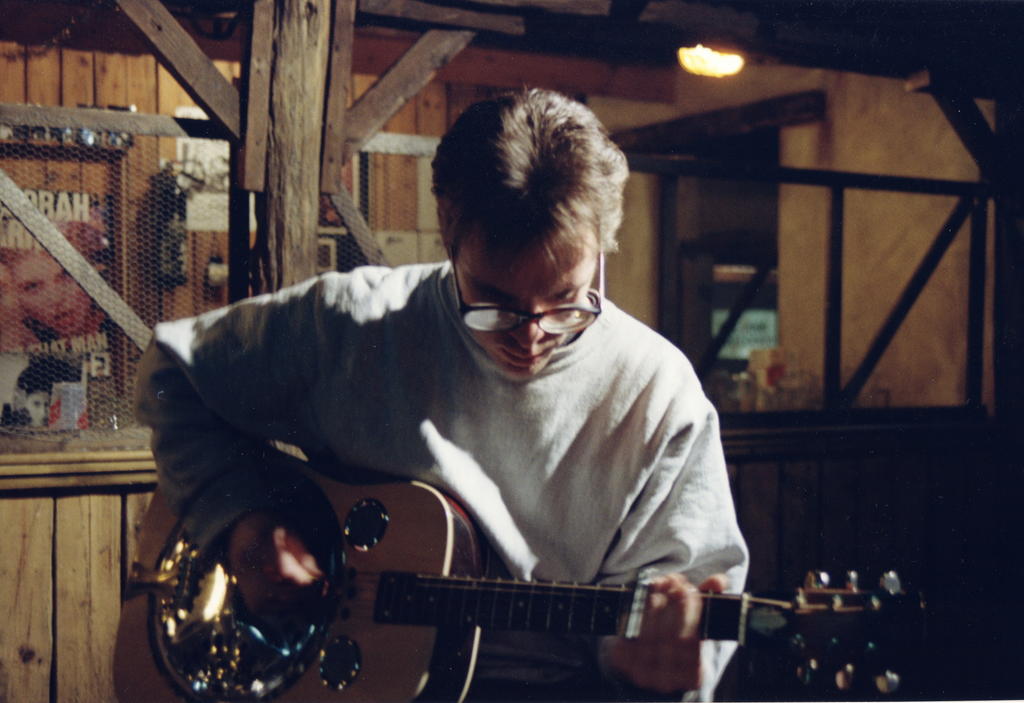
One of the happiest musical (and otherwise) experiences of my life has been to make the acquaintance of Phillip Marshall, guitarist and songwriter extraordinaire. We met working together at the same record store around 1986 or so, and eventually played in three bands together: The Colorblind James Experience, The Hotheads, and Lalaland. The last two were formed by Phil. My involvement in Lalaland was very brief, but I went to many of their gigs as an enthusiastic listener. All three groups offered tremendous riches to the Rochester (NY) music scene, and each will eventually get ample discussion on this blog, but for now, let me say that Phil's musical scope was far too vast to be contained within one group. Common to all of them was a deep appreciation for musical tradition (particularly the blues and the legacy of the Beatles), combined with an ambition to explore new territory. Aside from his musical skills, Phil is one of the kindest and most decent human beings alive. This is well-known to anyone who knows Phil personally, but is also evidenced in his songwriting. His songs display an extraordinary empathy and insight that is on a par with that of Ray Davies or Elvis Costello. More on that in a future posting. Happy Birthday, Phil.
Sunday, October 16, 2005
Unquenchable Enthusiasm(s)
For non-musical thoughts, fans of this blog will surely want to investigate the Enthusiasms of McIntire, easily accessed from the link just to your right. It's been kicked off in style with a terrific recipe for oyster stew... Check back often for updates. And more recipes.
Subscribe to:
Posts (Atom)